“I also looked at their children and wondered why they got so sick. This time the answer came rather quickly and from the mouth of an Aboriginal woman: ‘Before the white man came, we had good health and no sickness.’” — attributed to Dr. Archie Kalokorinos, who worked with the Australian aborigines and tried to protect them from being murdered by vaccines
by Steve Halbrook
see also: The Bible Versus Vaccination
Lies about Contagion
Many Christians in the name of the Great Commission or being salt and light have engaged in medical missions. It is noble indeed to want to assist the health needs of people. But the trouble comes when medical procedures employed are not thoroughly researched and considered — and the effects of said procedures are a blight upon the population.
Such is vaccination. And native populations have noticed — hurting the witness of the Gospel.
Imagine it this way. You are part of a native population. Then, those from another land visit your village with promises of peace. These visitors say they want to help save lives — and the means of doing so is via a needle that injects unknown substances into the body.
Anyone not desensitized to vaccination will recognize this as unnatural — maybe even dangerous. And so many in the village will immediately recoil and refuse such a procedure.
Others — perhaps against their better judgement — are willing to give it a try.
And then what happens? People fall ill. Some — maybe many — even die. Some survivors are never the same — beset with chronic illness the rest of their lives. The most tragic victims, of course, are the children.
The obvious conclusion by the natives would be that they are being poisoned — even deliberately.
(I, by the way, believe it very possible that the elites who controlled Britain behind the scenes were in fact deliberately culling the native population — but not the missionaries themselves who sincerely believed that vaccination is beneficial to health.)
Now, when such visitors share the Gospel to these villagers, how receptive will the indigenous population be? Might they close their ears because they have reason to believe that such people intend harm instead of good?
Let’s reinforce this caution with history as we look at the perception of many inhabitants of India when under British colonial rule. On missionary organizations, we read:
Christian missionary organizations played a major role in developing healthcare facilities throughout India. Through their medical facilities, which included hospitals, dispensaries, and clinics, missionary organizations brought modern healthcare to India by offering vaccination programs, sanitation programs, and public health knowledge dissemination. …
Doctors who came to India through missionary organizations served as vital forces against diseases, including cholera, malaria, and smallpox. Missionary healthcare workers provided essential services throughout rural and tribal regions because the British colonial administration failed to deliver satisfactory healthcare services (Crawford, 1914; Hunt, 2020). The study suggests that local communities sometimes distrusted the healthcare missions established by missionaries.
Chaman Shahzad Masih and Dr. Ghulam Shabbir, “The Role of Christian Missionaries in Colonial India: An Exploratory Study,” Pakistan Languages and Humanities Review, October-Dec 2024, Vol. 8, No. 4, 151.
Obviously, a major reason for opposition to missionary organizations would be the Gospel itself: it is an offense to those who are perishing. But — it doesn’t help when you promote an obvious poison alongside it.
India’s Mahatma Gandhi himself was opposed to vaccination, and says this about its obviously unsanitary nature:
[V]accination is a very dirty process, for the serum which is introduced into the human body includes not only that of the cow, but also of the actual small-pox patient. An average man would even vomit at the mere sight of this stuff. If the hand happens to touch it, it is always washed with soap. The mere suggestion of tasting it fills us with indignation and disgust. But how few of those who get themselves vaccinated realise that they are in effect eating this filthy stuff ! Most people know that, in several diseases, medicines and liquid food are injected into the blood, and that they are assimilated into the system more rapidly than if they were taken through the mouth. The only difference, in fact, between injection and the ordinary process of eating through the mouth is that the assimilation in the former case is instantaneous, while that in the latter is slow. And yet we do not shrink from getting ourselves vaccinated !
Mahatma Gandhi, A Guide to Health (Triplicane, Madras, S.E.: S. Ganesan, 1922), 108, 109.
(By the way, the disgusting, unsanitary beginnings of vaccination set the tone for the increasingly insane use of dangerous ingredients used in vaccines today.)
Such an unsanitary procedure will surely breed death; and so quite understandably, we find this complaint in 1890 by a pro-vaccine doctor about native Indians:
The affection for their children has driven them to regard vaccination as an operation intended by government to thin the number of its poor subjects. This dread, coupled with their religious scruples, have made them obstinately firm and resolute, and sound arguments are regarded as a worthless dodge to play on their minds to kill their own children.
The Indian Medical Gazette, “Dr. K. C. Bose on Small-pox in Calcutta.” (March 1890), 82. Accessible at https://europepmc.org/backend/ptpmcrender.fcgi?accid=PMC5149194&blobtype=pdf
This report was in 1890 — almost a century after vaccination was introduced in India. The natives, then, had plenty of time to see the horrific effect vaccination had on the population. And so — good intentions of missionaries notwithstanding — no wonder the natives believed vaccination was a tool of depopulation. (As many of us awake to vaccines in our own countries believe to currently be the case.)
This is not the only report. Here are a couple accounts of a 1903 vaccination campaign:
Tragically, the famine was followed by bubonic plague, which swept through Vellore in 1903. Many people were already weak from more than a year with little food, and Ida watched as about twenty patients a day perished from the plague. Although a vaccine was available, many people refused to take it. Rumors spread that European doctors were using the vaccine to murder Indian people and that the British Empire was paying them a good sum of money each time they succeeded.
Janet & Geoff Benge, Ida Scudder, Healing Bodies, Touching Hearts (Seattle, WA: 2019), 90.
But since the isolation of the Bacillus pestis in 1894 by a pupil of Pasteur, Haffkine’s vaccine formula had been perfected. Now, armed with this new weapon, government and medical workers set forth to grapple with the epidemic.
But their efforts only spread new panic. In Arni, Ranipet, Tindivanam, Vellore, people fled their homes, their fear of health officers and their strange inoculations worse even than that of plague. For the Black Death, despite its horror, was familiar. Like smallpox and cholera, they knew it as the visitation of Mari Amman, incarnation of Kali and Goddess of Death, to be accepted with outward reverence but inward terror, and to be averted only by flocking to her shrines with prayers and gifts. Not so the inoculations! Rumors became rife that the government was using them as a pretext for killing the Indian people and that doctors were paid so much a head for disposing of them.
Overnight the hospital emptied itself, and the daily stream of outpatients shrank to a mere dribble. Fearful of inoculations, even beggars and hucksters shunned the gate as if it were the entrance to a cobra den.
Dorothy Clarke Wilson, Dr. Ida: Passing on the Torch of Life (Friendship Press, 1976), 98.
It is only appropriate that the second quote describes vaccination as “a new weapon.” If so many feared vaccines more than the plague, then it may be a bit dishonest to dismiss their fears as “conspiracy-mongering.” Sounds more like they had firsthand experience with vaccination’s deadly effects.
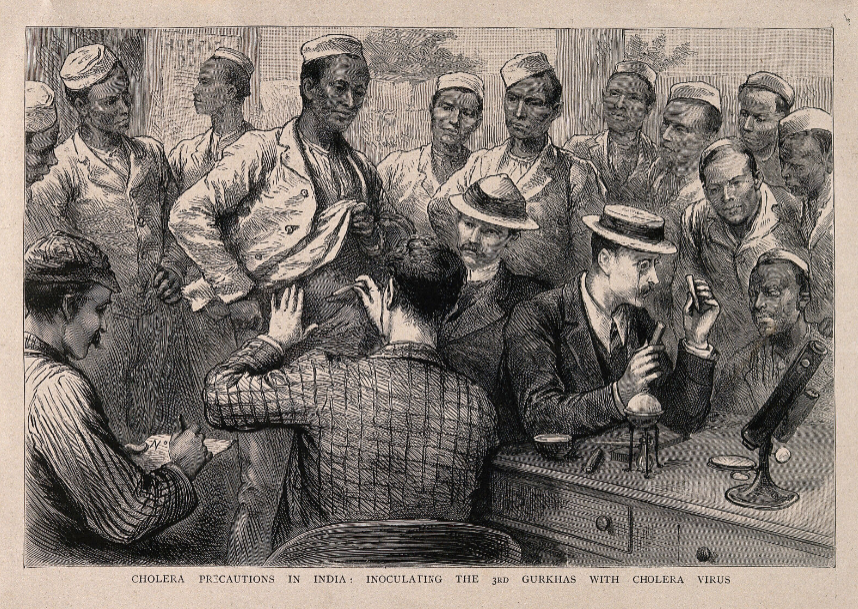
Ida Scudder (1870-1960) is a well-known female medical missionary whose father, Dr. John Scudder, sickened and died after getting vaccinated to set an example (and thus encourage) the local Indian population to vaccinate:
[H]e wrote to Ida and told her her of an ambitious program he dreamed of — to inoculate the local people against cholera. It was a procedure that had been known for only a few months.
Ida’s father was convinced that inoculation would save thousands of lives, and so he arranged for the government surgeon to pay a visit to Vellore. He then gathered all the local Christians together and explained to them how the inoculation worked.
Wanting to be sure they understood how simple it was, Dr. Scudder rolled up his own sleeve and was the first person in South India to be inoculated against cholera. Many brave Christians followed his example. …
Dr. Scudder was mobbed wherever he went — not by hostile crowds but by people wanting the inoculation themselves.Janet & Geoff Benge, Ida Scudder, Healing Bodies, Touching Hearts (Seattle, WA: 2019), 64, 65.
But Dr. Scudder’s example — far from showing the vaccine to be safe and effective — seemed to show the vaccine to be deadly. And so following his vaccination, we read:
Even though Ida was tired from the trip, she was alert enough to notice that her father was slower than she remembered him. When she was alone with her mother, she asked about her father. Her mother told her that he had not been the same since he inoculated himself against cholera.
Ibid., 76.
Before passing, Ida’s father “was plagued with large boils that left him weak and sore” and “had lumps as large as golf balls under both arms.” (Ibid., 81, 82)
This is tragic, of course, and we are not questioning Dr. Scudder’s sincerity; but this could not have helped the prejudice against missionaries: vaccination was deadly, confirmed not only by Dr. Scudder’s death, but time and time by experience by the native Indian population.
So let this be a lesson: let’s be sure that we are pushing moral actions when we try to win a people to Christ instead of immoral actions, such as with vaccination — despite it having the trappings of morality.
Of course, this problem is not restricted to missions — it is regarding churches as well. When church leadership push vaccines and attendees lose their child after taking their ill-founded advice, they are bringing reproach on the Christian message.
The Gospel can do without poison.
If you find this site helpful, please consider supporting our work.




So very sad. Good work exposing the evil.
Thanks Mischelle. So much to cover, so little time. Hope things are well for you!