by Steve Halbrook
As we have previously noted, the unscientific germ theory is neither provable via isolating viruses nor — at least from what we’ve seen regarding the cold and flu — contagion experiments. Apparently, the idea of dangerous, contagious germs is simply a convenient means for marketing vaccines.
We have also previously noted that changes in weather conditions are a good explanation for why population clusters get sick simultaneously (which might give the illusion of contagion, since many fall ill from such conditions about the same time). To be sure, there are other reasons that one or even a large number of people can fall ill, but we are talking about mass illness.
In short, it seems to be the air. But if it is the air, while in some cases weather changes might be the cause of particular illnesses, in others, it might be poisonous air.
Let’s look at history, where we can learn perspectives on particular views that we would never have thought of — let alone considered — otherwise.
In medieval times, the people — more influenced by Christianity regarding illness than those in our day — held that God’s wrath for sin is a major reason for disease. As far as secondary causes, J.N. Hays writes:
Within the general framework of a heaven-sent scourge, medieval thinkers offered a number of more immediate causes, and on the basis of those causes proposed (or put into effect) some remedies. At the head of the list of such immediate causes was “bad air,” the official doctrine of the medical faculties of some universities, where it was integrated with Galenic theory. Hot, moist air, putrified (ultimately by God’s action, to be sure), entered the lungs and caused a blood disorder. Plague resulted. But if widespread agreement existed on the role of bad air, great disagreement ensued about the source of that air. Some found its origins in the heavens; thus the Sorbonne cited an unfortunate conjunction of the planets that engendered bad air. Eclipses, always regarded as grave astronomical events, were another possibility. Comets — sublunary phenomena in the dominant Ptolemaic astronomy — were likely disturbers of sublunary air. …
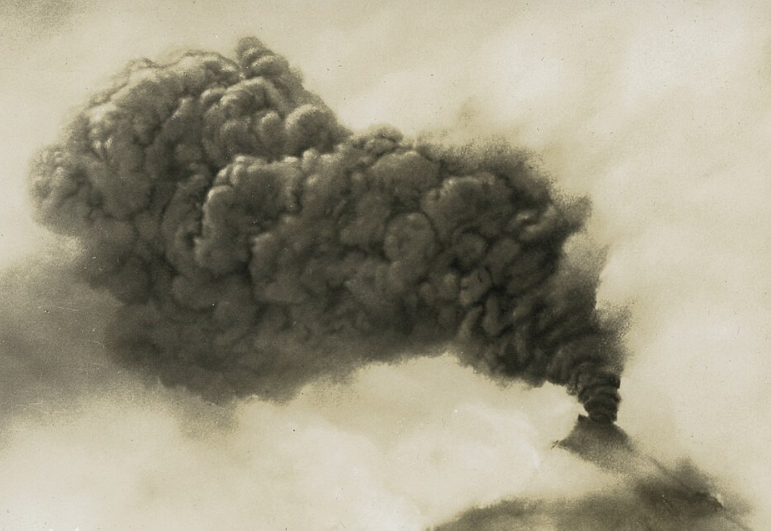
Others maintained that “plutonic,” not astronomical, forces produced bad air: corruption poured from openings in the earth such as volcanoes. Sicily, with both Mount Etna and early cases of plague, was especially suspect. Or perhaps the bad air merely accompanied a variety of natural cataclysms … [e.g., earthquakes – editor]
J.N. Hays, The Burdens of Disease: Epidemics and Human Response in Western History (New Brunswick, NJ: Rutgers University Press, 1998, 2003), 42, 43.
To be sure, there were those during this time who believed in contagion as well (although not based on germ theory). But here our focus is on poisoned air. And so in his book The Black Death, Philip Ziegler writes:
There must be some vicious property in the air itself which traveled slowly from place to place, borne by the wind or impelled by its own mysterious volition. There were many different points of view as to the nature of this airborne menace, its origin, its physical appearance. But almost every fourteenth-century savant or doctor took it for granted that the corruption of the atmosphere was a prime cause of the Black Death.
Philip Ziegler, The Black Death (NY: Harper & Row Publishers, 1969, 1971), 20.
Our quotes have referred to such things as comets, earthquakes, and volcanoes as sources of bad air that may have caused such things as the Black Death (1345-1353). How so? Because they flood the atmosphere with poisons.
First, consider The Report of the Paris Medical Faculty, October 1348, written during the Black Death:
Although major pestilential illnesses can be caused by the corruption of water or food, as happens at times of famine and infertility, yet we still regard illnesses proceeding from the corruption of the air as much more dangerous. This is because bad air is more noxious than food or drink in that it can penetrate quickly to the heart and lungs to do its damage. We believe that the present epidemic or plague has arisen from corrupt air in its substance, and has not changed in its attributes. …
And moreover these winds, which have become so common here, have carried among us (and may perhaps continue to do so in future) bad, rotten and poisonous vapours from elsewhere: from swamps, lakes and chasms, for instance, and also (which is even more dangerous) from unburied or unburnt corpses – which might well have been a cause of the epidemic. Another possible cause of corruption, which needs to be borne in mind, is the escape of the rottenness trapped in the centre of the earth as a result of earthquakes – something which has indeed recently occurred. …
However, in the judgement of astrologers (who follow Ptolemy on this) plagues are likely, although not inevitable, because so many exhalations and inflammations have been observed, such as a comet and shooting stars. Also the sky has looked yellow and the air reddish because of the burnt vapours. There has also been much lightning and flashes and frequent thunder, and winds of such violence and strength that they have carried dust storms from the south. These things, and in particular the powerful earthquakes, have done universal harm and left a trail of corruption. There have been masses of dead fish, animals and other things along the sea shore, and in many places trees covered in dust, and some people claim to have seen a multitude of frogs and reptiles generated from the corrupt matter; and all these things seem to have come from the great corruption of the air and earth. All these things have been noted before as signs of plague by numerous wise men who are still remembered with respect and who experienced them themselves.
The Report of the Paris Medical Faculty, October 1348. Source: R. Hoeniger, ed., Der Schwarze Tod (Berlin, 1882), appendix III, pp. 152-6. Retrieved August 29, 2025, from https://sites.uwm.edu/carlin/the-report-of-the-paris-medical-faculty-october-1348/
Next, consider this from the book What Really Makes You Ill (with quotes from a one Professor Baillie):
“There really is enough information about comets, earthquakes and ammonium to permit the quite serious suggestion that the Black Death was due to an impact by comet debris on 25th January 1348 as witnessed by the major earthquake on that day.” …
“Apart from ammonium, it is now known that a range of unpleasant, toxic and evil-smelling chemicals, including hydrogen sulphide and carbon disulphide, have been detected in recent comets.”
The presence of ‘evil-smelling chemicals’ would certainly explain the documented reports about the ‘corruption of the atmosphere’; their toxicity also explains how these chemicals would have caused severe respiration problems and rapid death from asphyxiation for those people in close proximity to the dense atmospheric poisoning.
Dawn Lester and David Parker, What Really Makes You Ill? Why Everything You Thought You Knew About Disease is Wrong (Dawn Lester & David Parker, 2019), 144, 145.
The authors go on to cite a one Herbert Shelton quoting from Berdoe’s Origins and Growth of the Healing Art:
“In 1337, four millions of people perished by famine in China in the neighbourhood of Kiang alone. Floods, famine and earthquakes were frequent, both in Asia and Europe. In Cyprus a pestiferous wind spread a poisonous odor before an earthquake shook the island to its foundations, and many of the inhabitants fell down suddenly and expired in dreadful agonies after inhaling the noxious gases. German chemists state that a thick stinking mist advanced from the East and spread over Italy in thousands of places, and vast chasms opened in the earth which exhaled the most noxious vapors.”
These conditions can be explained by comets, comet debris and earthquakes; they cannot be explained by rat fleas ‘infected’ with disease-causing bacteria.
Ibid., 145, 146.
Today when there is mass illness that might be attributed to something beyond mere weather changes, we have to ask ourselves whether poisonous air is involved. And not just as a natural occurrence — today, we are constantly bombarded with man-made poisons to the air. How many “outbreaks” in recent history might be attributed to such?
A couple of examples: Spanish Flu and polio. Regarding the former,
[M]any other doctors at the time were unconvinced that military flu deaths were largely attributable to the pandemic. This is because, as the first gas victims began arriving at field hospitals, attending doctors could not help but draw parallels between the pathology of Spanish influenza and battle gas exposure. … Even revered influenza experts acknowledged how reminiscent the lesions of Spanish flu infection were to poison gas inhalation. … [T]he symptoms of battle gas victims align very closely with those of Spanish flu patients.
Daniel Roytas, Can you Catch a Cold?: Untold History & Human Experiments (Daniel Roytas, 2024), 156.
(And as far as civilian “Spanish Flu” cases, perhaps the greatest cause was actually poisoning via high dose aspirin — pushed as a “treatment” for the supposed flu. [Roytas, Can you Catch a Cold?, 159]).
Regarding “polio,” much of what is called polio correlates with the use of pesticides (other reasons here) — and traces all the way back to the late 1800s:
The widespread problems because of poliomyelitis began in 1894, Vermont, and began its decline in 1952 across the farms and swimming holes of America, as the planes and trucks began to pay closer attention to the munitions they dropped on children throughout the nation. As long as the battle of humans, their lead arsenate, and their DDT against the gypsy and codling moths remains forgotten, the parade of iron lungs at Rancho Los Amigos in 1953 will continue to haunt the dreams of mothers and fathers everywhere.
Forrest Maready, The Moth in the Iron Lung: A Biography of Polio (Feels Like Fire, 2018), 256.
In short, “polio” was no virus, but mass poisoning of the air via pesticides — perhaps the worst being DDT.
(Vaccination, too, might account for a decent chunk of the Spanish Flu and polio “cases.”)
With this in mind — and the fact that we are not accustomed to considering causes of mass illness beyond germs — we can see that all the Globalist oligarchs have to do is fire off aerosolized poison from a truck or dump it from the sky via a drone or aircraft — cry “virus virus!” — and here we are again with another “pandemic.” (But of course, chemtrail spraying from planes occurs daily — what is the overall effect of this on our health, both long- and short-term?)
However, knowledge that mass illness can instead be something (e.g., bad air) instead of microbes can help us see through the deception and adjust our “pandemic” response accordingly.
The reality that mass illness can be caused by poisoned air helps us to see that not everything can be attributed to contagion — and perhaps, nothing can.
And in any case, poisoned air or not, there is never a rational reason for poisoned injection — vaccination — as the solution.
If you find this site helpful, please consider supporting our work.